RamPINN Logo

RamPINN: Recovering Raman Spectra From Coherent Anti-Stokes Spectra Using Embedded Physics

Computer Vision Group
Friedrich Schiller University Jena, Germany
AISTATS 2026

Abstract

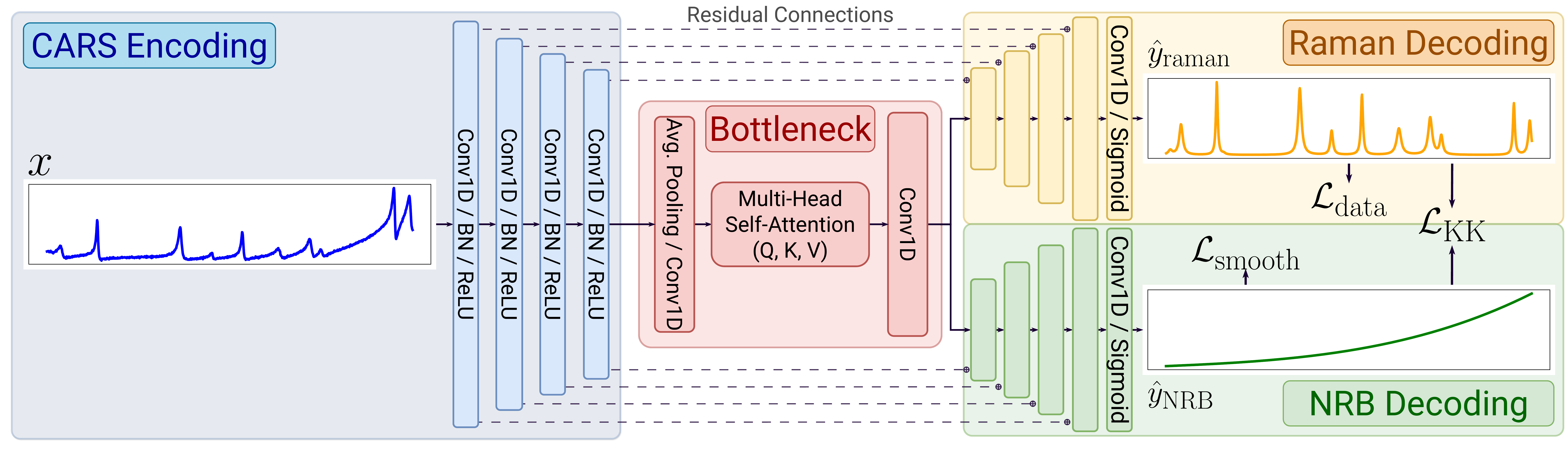
Transferring the recent advancements in deep learning into scientific disciplines is hindered by the lack of the required large-scale datasets for training. We argue that in these knowledge-rich domains, the established body of scientific theory provides reliable inductive biases in the form of governing physical laws. We address the ill-posed inverse problem of recovering Raman spectra from noisy Coherent Anti-Stokes Raman Scattering (CARS) measurements, as the true Raman signal here is suppressed by a dominating non-resonant background. We propose RamPINN, a model that learns to recover Raman spectra from given CARS spectra. Our core methodological contribution is a physics-informed neural network that utilizes a dual-decoder architecture to disentangle resonant and non-resonant signals. This is done by enforcing the Kramers-Kronig causality relations via a differentiable Hilbert transform loss on the resonant and a smoothness prior on the non-resonant part of the signal. Trained entirely on synthetic data, RamPINN demonstrates strong zero-shot generalization to real-world experimental data, explicitly closing this gap and significantly outperforming existing baselines. Furthermore, we show that training with these physics-based losses alone, without access to any ground-truth Raman spectra, still yields competitive results. This work highlights a broader concept: formal scientific rules can act as a potent inductive bias, enabling robust, self-supervised learning in data-limited scientific domains.

Methodology

RamPINN Architecture

Overview of the RamPINN architecture. Our model uses a dual-decoder structure to disentangle the resonant Raman signal from the non-resonant background in CARS spectra, guided by physical constraints.

Qualitative Evaluation

Qualitative Results

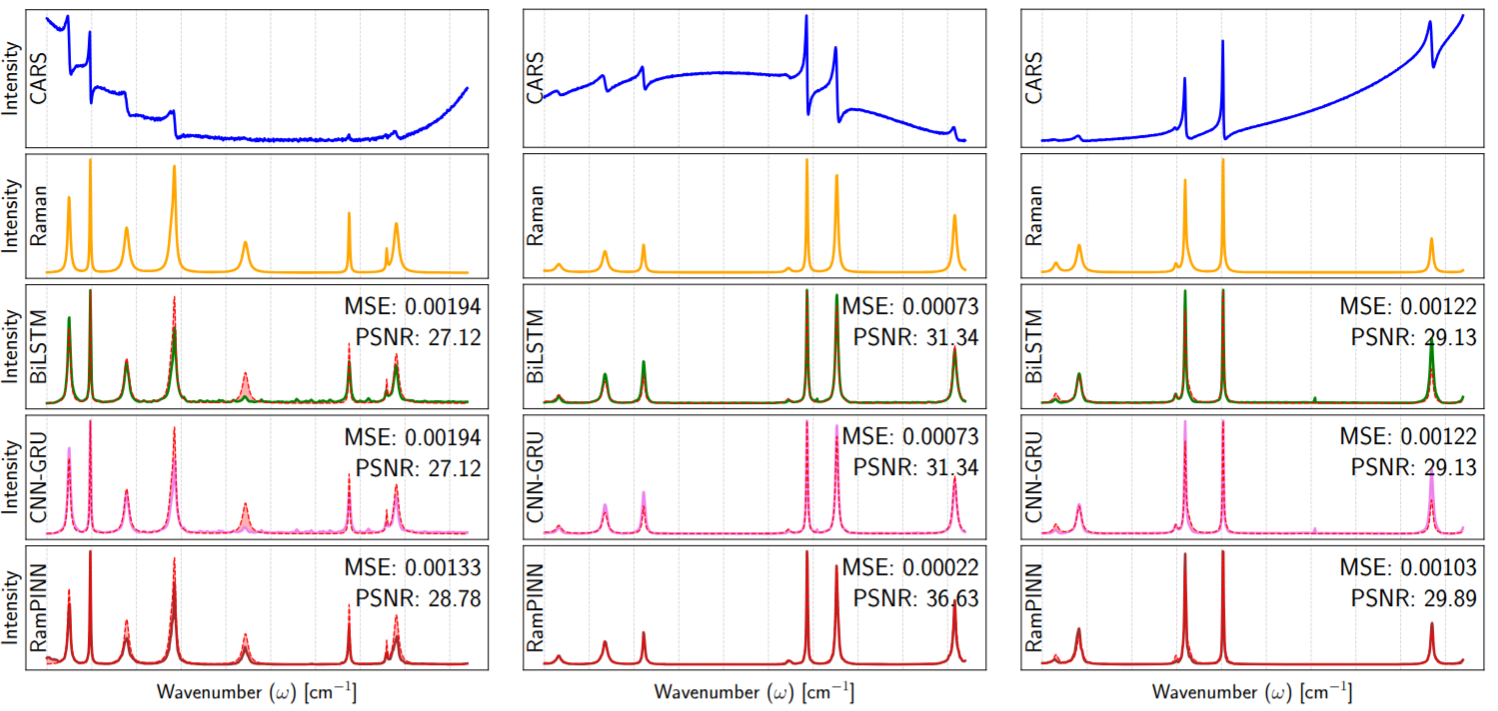
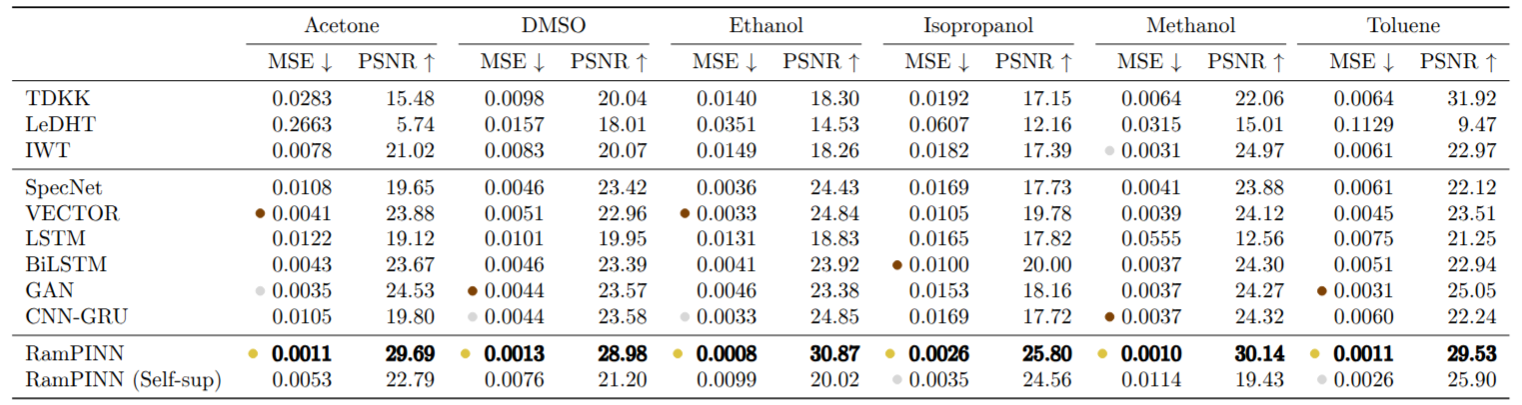
We compared RamPINN against several existing architectures on synthetic data. In the qualitative reconstruction image above, you can see how from the input CARS (first row, blue) the Raman spectrum (second row, yellow) is recovered by these methods. RamPINN achieves the best performance for both MSE and PSNR. These results transfer even to real life samples, see the table below, where the performance is indicated via gold, silver, and bronze medals. Here, RamPINN outperforms all methods.

Current Benchmarking Results
Quantitative Results

We will try to keep this numbers updated for new methods!
Instructions on how you can provide results for YOUR method can be found at the GitHub repository.

Acknowledgements

This work was conducted at the Computer Vision Group, Friedrich Schiller University Jena, Germany. This study was partially supported by the European Union’s Horizon Europe research and innovation program for the project uCAIR with Grant Agreement No. 101135175.

BibTeX

If you find our work useful, utilize with our models, start your own research with our data set, or use our parts of our code, please cite our work:
@inproceedings{vemuri2026rampinn,
      author = {Sai Karthikeya Vemuri and Adithya Ashok Chalain Valapil and Tim Büchner and Joachim Denzler},
      title = {RamPINN: Recovering Raman Spectra From Coherent Anti-Stokes Spectra Using Embedded Physics},
      year = {2026},
      doi = {10.48550/arXiv.2510.06020},
      booktitle = {The 29th International Conference on Artificial Intelligence and Statistics (AISTATS)},
}